A miniature building, a sculpted object or a recognizable product can give a custom award a very direct connection to the achievement it represents. When the shape itself carries the idea, sculptural resin or cast metal can be worth the extra work.
They also ask more of the budget and schedule. If the pieces are needed in a hurry, or the budget leaves little room for development, I would usually recommend a different approach.
The useful question is whether a sculpture adds enough to this particular project to justify what it takes to make it.
When a sculptural piece makes sense
Some subjects are understood through their form. The profile of a building, the pose of a figure or the shape of a product may be what makes the design recognizable. Making that subject into a small physical object can give people something they want to pick up, turn around and keep on their desk.
That can be a good reason to explore a sculptural design. Simply wanting something more elaborate is less helpful. Before choosing resin or cast metal, we should be able to explain what the dimensional form contributes.
It helps if you have:
A meaningful subject whose shape is central to the idea.
Enough time for development, a physical sample and the finished order.
A budget that allows for setup as well as the pieces themselves.
Agreement within your team about the main design direction.
Our sculptural project examples show how pose, proportion and surface detail contribute to different finished pieces.
Why these pieces take time
“3D modeling” describes the digital work used to develop the shape. It is one part of making a sculptural award. A model on a screen still has to become a physical object.
A common route for molded resin work begins with a digital model. A physical master is then produced, often by 3D printing, and used to make a mold. Resin is cast in the mold to create the individual pieces. Those pieces need to be removed, cleaned up and finished. Many are then painted by hand and assembled with a base or other components.
Each stage depends on the one before it. Small details that look straightforward in artwork can require careful work in the model, the mold and the finishing. Painting adds another layer of individual attention.
The route can vary. Some resin components are printed directly rather than molded, and different designs require different construction and finishing methods. Cast metal has its own tooling, casting and finishing requirements; it should have a project-specific estimate rather than simply borrowing the resin schedule.
Our visual guide to the modeling process shows the relationship between artwork, digital models and physical pieces.
A sample date is only part of the schedule
For custom molded resin work, we often require around 21–25 days for an initial sample. Some projects take longer. Treat that as an early planning guide rather than a promised turnaround. That estimate covers the sample stage - not the time for the entire finished order - and it does not include shipping/transit time. The project quote should also make clear when the sample lead time begins, including any required approvals.
The schedule also needs to allow for design development, any revisions, sample review, production of the remaining quantity and shipping. If a physical sample needs to travel for review, that adds another step.
Cast-metal pieces can require longer development, depending on their construction and finish. Material choice also affects what can be made: a delicate form that works in resin may need substantial changes to work in cast metal. We confirm feasibility, sequence and timing for the actual design.
The date that matters most is the day you need the pieces in hand. Starting with that date lets us work backward and see whether the proposed approach is realistic. It also helps to distinguish three milestones:
When the first sample should be available for review.
When the completed order should be ready to ship.
When the pieces need to arrive at their destination.
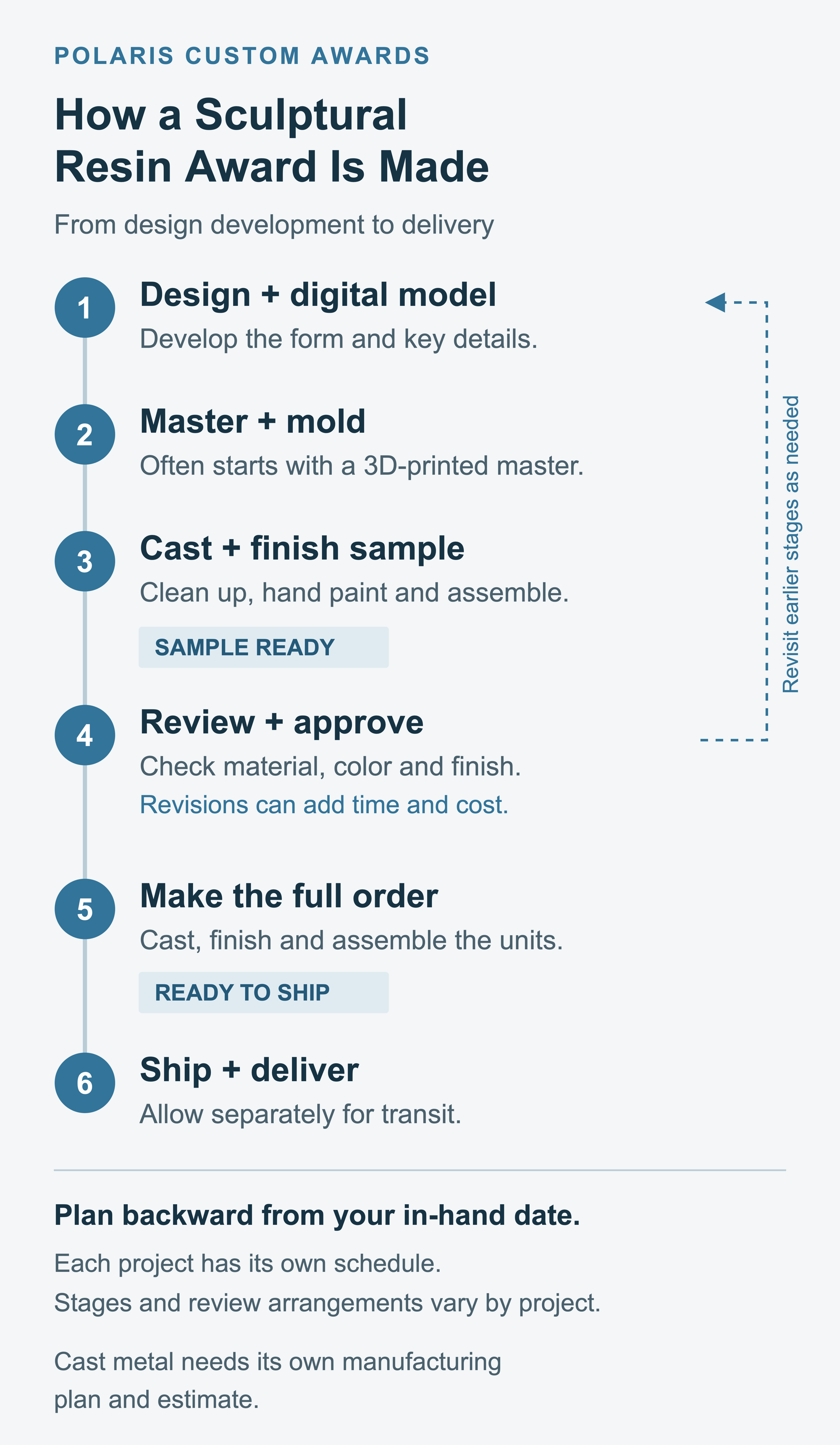
A common molded-resin workflow. The first sample, the completed order and delivery are separate milestones. Revisions can send work back to an earlier stage.
If your event is only a few weeks away, a newly developed sculptural piece is generally a poor starting point. A simpler construction may give us a much better chance of producing something appropriate within the time available.
What to allow in the budget
Custom molded resin setups often start around $600 and can reach $1,000 or more. Sculptural pieces often start around $200 each, with size, quantity, complexity and finishing affecting the price. These are rough planning figures in US dollars, not a quotation for a particular design. Cast-metal work needs its own estimate.
Setup and the per-piece price are separate parts of the budget. Setup pays for work needed to develop and prepare the design for manufacture. The piece price reflects the work of making each finished unit.
Quantity matters because the setup cost is spread across the order. For illustration, a $600 setup adds $120 per piece to an order of five, or $30 per piece to an order of twenty, before the piece price and delivery costs. Ordering more pieces does not remove the casting, finishing and assembly work each one requires.
Ask for a complete estimate covering development and setup, the finished quantity, packaging, shipping and any applicable taxes or duties. The general project planning guide compares broader design categories and their starting budgets.
Settle the important details early
Changes are easier to consider before a physical master or mold has been made. Altering the shape later may mean repeating development work or making new tooling, which can add cost and time.
That is why it helps to identify the essential features early: the silhouette, proportions, pose and any details that make the subject recognizable. Where useful, model views help us review those features before moving further into production.
The review process depends on the project. A digital model can help assess geometry, but the physical sample tells us more about material, color, finish and assembly. Polaris reviews the prototype before authorizing the full production run; client review may involve photographs, video or an in-hand sample, as appropriate.
We will explain the effect of a proposed change before proceeding. A lettering adjustment and a redesigned sculpture can involve very different work.
When another approach is a better choice
A tight deadline is a good reason to reconsider a new custom sculpture. So is a budget that would be consumed by the development and setup before the order is made.
You can often preserve the idea through a different construction. A recognizable building might be represented by a cut shape with carefully prepared printing. A product or piece of equipment might work as an image within a clear design. Layered components can introduce depth without reproducing the entire subject as a miniature.
These alternatives still need a realistic schedule and a project-specific quote. Their advantage is that they may avoid some of the modeling, mold-making and hand-finishing required by a fully sculptural piece.
A good recommendation should account for the achievement, the people receiving the piece and the practical requirements of the order. Sometimes that leads to a detailed sculpture. Sometimes a simpler design communicates the idea more clearly and fits the project better.
Start with the idea, budget and in-hand date
If you are considering a sculptural resin or cast-metal award, send us the subject or reference, approximate quantity, budget range and the date and destination for delivery.
We can then discuss whether a sculptural approach makes sense, what development would be involved and which alternatives are worth considering.